

I prompted Google Gemini 3.1 Pro with: You are an expert demographer. Based on statistics for England and Wales I’d like an estimate, with range statistics, for the number of siblings, first, second and third cousins of the same generation a person born in 1945 might have. Show your reasoning and list in priority order the sources of variation.
The summary response was: TL:DR: For a person born in England and Wales in 1945, the estimated kinship network in their own generation is approximately 2 siblings (range 0-6), 13 first cousins (range 0-30), 115 second cousins (range 20-250), and 1,160 third cousins (range 200-3,000).
Then I prompted to “Please double check your estimates in responding to my initial prompt.”
The summary reponse was: TL:DR: A rigorous audit of my original demographic model reveals that while the mathematical logic was sound, I made a terminological slip in the text and used rounded fertility inputs that created a compounding overestimate for distant cousins. The refined, data-accurate point estimates are 2 siblings, 12 first cousins, 100 second cousins, and 975 third cousins.
The corrected values are well within the range of variation in the initial response.
Compare that to the three-child family scenario of 2 siblings, 12 first cousins, 72 second cousins, and 432 third cousins.
To the query about sources of variation, Gemini responded.
“Demographic averages mask massive individual variance. The ranges above are vast due to the following factors, listed in priority order of their impact on the final numbers:
-
Variance in Reproductive Success: Family size often follows a negative binomial distribution. A single ancestor having 12 children who all survive to reproduce will exponentially blow up a cousin network, while a branch experiencing childlessness immediately terminates that line of descent.
-
Childhood Mortality & Nuptiality: Historical fertility rates measure live births, but not all children survived to reproductive age. For the 1825 and 1855 cohorts, infant mortality in England and Wales was notoriously high (often 150+ deaths per 1,000 births). Furthermore, a significant percentage of adults never married or had children (up to 15-20% in some Victorian cohorts).
-
Social Class and Geography: The demographic transition (the shift from high to low fertility) hit different groups at different times. Middle-class professionals in Southern England began limiting family sizes decades before manual labourers in the industrial North or rural Wales. A person descending from a line of coal miners would likely have a significantly larger kinship network than someone descending from a line of London clerks.
-
Endogamy and Pedigree Collapse: In rural or highly tight-knit communities, cousins often married one another. If a person’s great-grandparents were second cousins, the number of distinct ancestors drops, which mathematically reduces the number of unique third cousins in the present generation.”

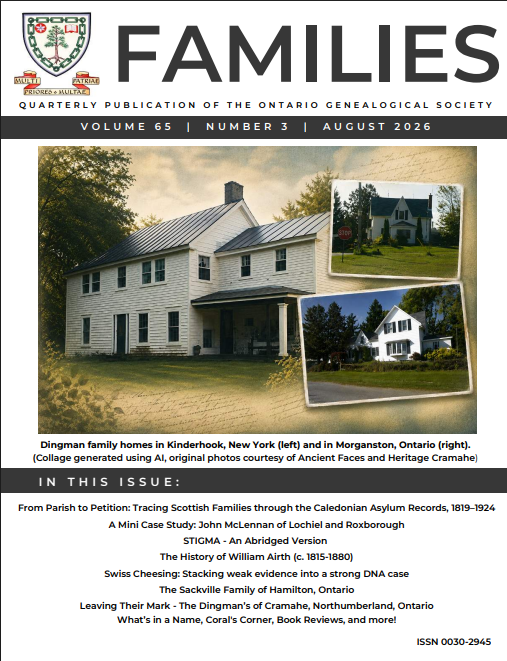 Volume 65, Number 3 of the OGS Quarterly publication is online for members. Contents are:
 Many record collections are too small and niche to attract the interest of the large genealogy companies, but none-the-less valuable. Often you’ll find them in the UK at local archives, county record offices and museums. It’s good practice to check those where you have ancestry periodically.