
This Weeks Online Genealogy Events

Choose from these selected free online events. All times are Eastern Time, unless otherwise noted. Registration may be required in advance—please check the links to avoid disappointment. For many more events, mainly in the U.S., visit https://conferencekeeper.org/virtual/


Tuesday, 3 February

2:00 PM, Ottawa Virtual Genealogy Drop-In for OGS (Ottawa Branch)
https://ottawa.ogs.on.ca/

2:30 PM, The Commissioner and Mr. Coughlin: Two Immigrants, One Murder, and a Search for Origins, by Brendan Wolfe for Allen County Public Library Genealogy Center
https://acpl.libnet.info/event/15525705

7:30 PM, Scoundrel BINGO, by Janice Nickerson for OGS (Durham Branch)
https://timetraces.com/durhambranch/

8:00 PM, English Context – History, Sources and Repositories, by Paul Milner for Legacy Family Tree Webinars
https://familytreewebinars.com/

10:00 PM (7:00 PM PT),
Exploring Genetic Genealogy: Introductory DNA, by Debra Cole for the British Columbia Genealogical Society,
https://www.bcgs.ca/

Wednesday, 4 February

11:30 AM, Advanced Census Research: Understanding Census Enumerators and Their Instructions, by Annette Burke Lyttle for Legacy Family Tree Webinars
https://familytreewebinars.com/

12:45 PM, The Many Faces of the Census: Beyond the Population Schedule, by Cheri Hudson Passey for Legacy Family Tree Webinars, https://familytreewebinars.com/

2:00 PM, Case Studies in Census Conflicts – Resolving Contradictions Across Decades, by Cheri Hudson Passey for Legacy Family Tree Webinars, https://familytreewebinars.com/

3:30 PM, Context in the Count: Interpreting the U.S. Census, by Elizabeth Swanay O’Neal for Legacy Family Tree Webinars, https://familytreewebinars.com/

7:30 PM, AI in Genealogy, Is it really new? by Gordon McBean for OGS (Huron Branch)
https://ogs.on.ca/events/

8:00 PM, Foundations in AI for Family History: Smart Tools, by Andrew Redfern and Fiona Brooker for Legacy Family Tree Webinars, (Members’ exclusive)
https://familytreewebinars.com/

Thursday, 5 February

1:00 PM, Death Investigation: What Do Coroners Do? by Peter Thornton for Gresham College.
https://www.gresham.ac.uk/whats-on/death-coroners

7:00 PM, Investigative Genetic Genealogy: What Is It and How You Can Help by Marie Palmer for OGS
https://ogs.on.ca/

Friday, 6 February

2:00 PM, Essential Skills: Hail the Hunter Gatherer—Finding What You Already Have by Dave McDonald for Legacy Family Tree Webinars, https://familytreewebinars.com/

Saturday, 7 February

11:00 AM, The Terrible Silence – Maritime Disasters and Tragedy at Sea by Charlotte Ward-Kelly for International Society for British Genealogy and Family History (ISBGFH),
https://isbgfh.com/


Note: Don’t forget to mark your calendars for Saturday, 14 February. I will be presenting “Rain Soaked Roots” for BIFHSGO, exploring the fascinating ways weather impacted our ancestors’ lives and the records they left behind.

O/T: Gemini

The Gemini Ai app from Google is gaining ground. While ChatGPT is still #1, I find myself using Gemini more and more. There’s a lot you can do with the free version. What’s not to like about that?

There’s a new YouTube video that explores Gemini in depth. It taught me a thing or two, notably about Canvas and Gems. Do pause the playback as you move through it to try features; otherwise, the accumulation of information gets overwhelming.

Don’t miss the section right at the end so you can benefit from the smartphone app.

Link to the video, How To Master Google Gemini in 2026 (Free Course), at https://youtu.be/-_FizlRlfYs?si=LFeAKAPkPL8AAe2k

Ancestry adds Yorkshire Parish Records

Ancestry has just released four major collections from the East Riding of Yorkshire, with nearly 500 years of parish records and over 5 million new entries. Hull and Scarborough are the largest communities among the 150+ parishes included. They are complete with links to original record images.

  • Baptisms, Marriages, and Burials (1538–1812): This unified collection for early research begins with the inception of parish registration under Henry VIII and continues through the introduction of standardized printed registers. It contains approximately 1.7 million records.

  • Baptisms (1813–1925): Covering the industrial revolution and the Victorian era, this set of 1.6 million records is essential for identifying parents’ names and occupations during a period of significant migration.

  • Marriages and Banns (1754–1950): With 1.2 million records, this collection includes the more detailed information required after Lord Hardwicke’s Marriage Act, often providing the names of fathers and witnesses in later years.

  • Burials (1813–2000): This final set of 435,000 records helps close the loop on family stories, offering a path to locating final resting places well into the modern era.

Groundhog Day — Folklore vs. Fact

Despite the fanfare, scientific analysis confirms that groundhogs are more celebrity than climatologist.

Studies, including a 2021 assessment by Lakehead University, show a consistent 50% groundhog accuracy rate. That’s like tossing a coin.

The NOAA Data: The National Oceanic and Atmospheric Administration reports that Punxsutawney Phil has been right only 40% of the time over the last decade.

Reliable vs. Unreliable Animal Signs
Our ancestors looked tothese signs to manage crops and travel. While some are grounded in biology, others are purely mythical.

High Reliability (Short-Term)
These behaviours are biological responses to immediate environmental changes:

Low-Flying Birds: They descend as barometric pressure drops; the thinner air makes high-altitude flight difficult before a storm.

Bees: Often return to the hive en masse just before rain due to sensitivity to static electricity and moisture.

Sharks: Move to deeper waters when they sense a drop in hydrostatic pressure, often predicting hurricanes.

Low Reliability (Long-Term)
These are popular myths with no statistical backing for seasonal forecasting:

Woolly Bear Caterpillars: The width of their bands reflects the previous season’s conditions and age, not the upcoming winter.

Cows Lying Down: Research shows cows lie down frequently to chew cud; there is no proven link to imminent rainfall.

Tune into my online-only BIFHSGO talk Rain-Soaked Roots: Weather Shaped the Lives of Our British Isles Ancestors / 10 a.m. EST on 14 February. Tune in at 9 am for Paul Cripwell on Exploring Pictures with AI: the Good and the Bad.

Find out more at https://www.bifhsgo.ca/events


Time Travel via Map: Join the National Library of Scotland’s Webinar

Ever wondered what stood exactly where your house is two hundred years ago? Or perhaps you’re a researcher looking to overlay historical land boundaries onto modern satellite data?

At 10 am EST on Wednesday, 11 February, the National Library of Scotland (NLS) is hosting a deep-dive workshop that turns its massive map archive into a high-tech time machine. If you’ve ever played around with their map viewer but felt like you were only scratching the surface, this is the session for you.

Don’t miss out. Spaces fill quickly. If interested,, register now for this free workshop via the official NLS website:

Register Here: NLS Georeferenced Maps Workshop

Sunday Sundries

Miscellaneous items I found interesting this week.

Wikipedia: Unusual articles
Articles that Wikipedians have identified as being somewhat unusual.  For unusual contributions that are of greater levity, see Wikipedia: Silly Things.

The Broomfield Bible of Charles I

Ancestry updated its complete Find a Grave collection on 29 January

AI systems could use Met Office and National Archives data under UK plans

Thinking Out Loud Together: Why Civil Discourse Matters More Than Ever
An in-person event on
Wednesday, 25 February at 7 pm at Library and Archives Canada in cooperation with the Ottawa Public Library. A special event during Freedom to Read Week 2026 with Randy Boyagoda, novelist and Professor of English at the University of Toronto, where he also serves as the university’s advisor on civil discourse.

Thanks to the following individuals for their comments and tips: Anne Sterling, Ann, Anonymous,  Brenda Turner, Donald Read, Gail, J-Rod, Teresa, Unknown.


Findmypast Weekly Update

This week, FMP’s East Midlands collections receive a boost with nearly 24,000 new records from Northamptonshire and Lincolnshire.

Northamptonshire Militia Lists, 1762–1819
Records added: 7,687

During this period of the Napoleonic Wars, able-bodied men aged 18 to 45 were balloted for militia service. Transcribed from original records at Northamptonshire Archives, the collection includes county-wide lists from 1762, 1771, and 1781, as well as Supplementary Militia returns for specific areas like Wellingborough, Brackley, Towcester, Kettering, and Higham Ferrers. The 1798 Posse Comitatus covers 28 parishes in the Northampton area. Each entry records name, occupation, and location.

Northamptonshire Land, Poll & Window Tax Lists
Years covered: 1625–1805
Records added: 2,630

Transcribed from Northamptonshire Archives, the collection includes Land Tax returns for 1801 covering most parishes and Northampton in 1805, givng property occupiers, owners, and tax amounts. Window Tax records, an indicator of property size and wealth, cover Higham Ferrers hundred (1750), Cleyley and Towcester hundreds (1772), and combined Land & Window Tax for Daventry (1776 & 1779) and Wellingborough (1782). The collection also includes a 1625 Subsidy list for the north and eastern parishes and the 1698 Poll Tax for Huxloe, Rothwell, and Corby hundreds, listing heads of households.

Northamptonshire Memorial Inscriptions
Years covered: 1404–2022
Records added: 8,421

Transcribed by the Northamptonshire Family History Society, these records cover 38 cemeteries, churchyards, and memorial sites. Each entry provides the full inscription text, dedication, monument type, birth and death years, and age at death.

Lincolnshire, Workhouse Guardians’ Minutes
Years covered: 1863–1902
Records added: 5,133

These detailed minutes from seven Lincolnshire unions, Boston, Bourne, Caistor, Gainsborough, Grantham, Holbeach, and Lincoln, record decisions about pauper admissions, outdoor relief payments, settlement disputes, apprenticeships, marriage notices, and bastardy cases. Each entry typically includes names, residences, dates, and often rates paid or biographical details.

Newspapers
The British Newspaper Archive, source for FMP newspapers, added three new titles: World and his Wife (1904-1908), Telescope (1824-1825), and Cycle Record (1888-1890). Updates were to 12 existing publications, notably the Edinburgh Evening News (80,500 pages from 2001-2004), Peterborough Advertiser (43,092 pages from 1989-2005), and Wakefield Express (29,860 pages from 1986-1991). The earliest starts in 1849.

Library Update

The Ottawa Public Library has a new brand. The old one was a familiar friend. It didn’t take me long to decide I like the change.

The rebranding reminds us that public libraries are the quintessential third place, sanctuaries where presence alone is enough. Unlike cafes that expect purchases or malls designed to encourage spending, libraries welcome everyone through their doors. There’s no economic barrier; most of the funding comes from property taxes already paid.

There’s so much to enjoy. Public libraries offer free access in-branch to major databases such as Ancestry.ca and serve as FamilySearch affiliates. Other commercial resources may be available free online. Collections of local historical records, city directories, old newspapers on microfilm, and regional history books that may be out of print or unavailable elsewhere are likely available at a central library. Interlibrary loan systems allow access to materials from across the country.

Do you take advantage? 

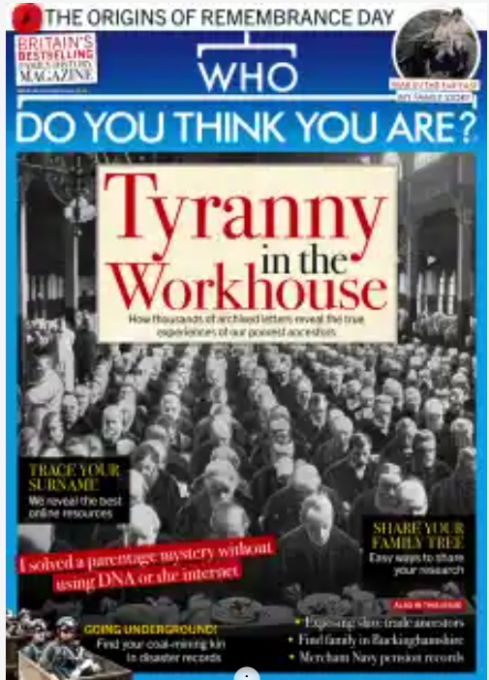
WDYTYA Magazine: February 2026

There are three feature articles in this issue.

Become a Pro with Ancestry
Debbie Kennett  puts Ancestry’s Pro Tools membership through its paces  is it worth the cost of upgrading?  Debbie reviews the various tools, tests with a case study, concluding it lives up to its name – of more value for the Pro. If tempted, try a one-month subscription.

Solving DNA Dilemmas
Claire Vaughan examines the fulfilling work of DNA Angles.

 A Taste of Home
Jo Thompson explores the wit, grit and wartime spirit of the oft-overlooked NAAFI women.  As Sir James Grigg, Secretary of State for War, said: “The work of the NAAFI is indispensable to the efficiency and well-being of the army.”

Under Research Advice, Jonathan Scott selects the best free sites for beginners with roots in Britain;  Nicola Morris explains how to research an ancestor who taught in Ireland; Chris Paton explains how wills were
recorded and executed in Scotland, and Nick Peers reveals how to use RootsMagic to create successful Ai prompts.

FamilySearch England, Wales, and Scotland Collections Update

Several FamilySearch Records (not Full Text) collection titles covering England, Wales, and Scotland have been updated between January 25-26, 2026.

England

England Births and Christenings (1538-1975), containing over 39 million records.
England Marriages (1538-1973), including more than 10 million entries.
The National Index of Wills and Administrations for England and Wales (1858-1957), with 8.4 million records.

The British Newspaper Archive Family Notices collection contains 4 million records, while the Obituaries collection contains 723,000 records.

Wales

Multiple Welsh county parish register collections have been updated:

  • Glamorganshire Parish Registers (1538-1912): 734,794 records
  • Denbighshire Parish Registers (1538-1912): 692,437 records
  • Flintshire Parish Registers (1538-1912): 498,887 records
  • Carmarthenshire Parish Registers (1538-1912): 464,062 records
  • Brecknockshire Parish Registers (1538-1912): 202,792 records
  • Caernarvonshire Parish Registers (1538-1912): 93,339 records
  • Glamorgan Parish Register Marriages (1837-1923): 56,282 records

Scotland

Scotland Church Records and Kirk Session Records (1658-1919) containing 235,176 records.

United Kingdom

United Kingdom World War I Service Records (1914-1920) with 4,215,127 records.

First Name Trends: Saving us from John and Mary

In England, in the 18th and 19th centuries, the most common given names were John, Thomas, William, Richard, and Robert for boys, and Mary, Elizabeth, Ann/Anne, Sarah, and Jane for girls.

Their predominance was reinforced by traditional naming patterns

1st Son: Father’s father (Paternal Grandfather)
2nd Son: Mother’s father (Maternal Grandfather)
3rd Son: The father
4th Son: Father’s eldest brother
1st Daughter: Mother’s mother (Maternal Grandmother)
2nd Daughter: Father’s mother (Paternal Grandmother)
3rd Daughter: The mother
4th Daughter: Mother’s eldest sister.

Things began to change in the 20th century, as shown by Office for National Statistics spreadsheets for England and Wales. John and Mary fell out of the top 100 names. The top names now, Muhammad and Olivia, don’t appear in the lists until recently.

Since the mid-20th century, there’s the influence of popular culture and music.

Michelle
​The Beatles released Michelle in December 1965 on the album Rubber Soul. While the name was already gaining popularity, the Beatles caught the wave. Michelle birth registrations doubled in one year, based on FreeBMD data.

Registrations remained above 7,500 annually before gradually declining.

Tammy
Another case with a jump in registrations. I thought it might occur following the release of Debbie Reynolds 1957 hit from the film Tammy and the Bachelor.

The name does not appear in FreeBMD until 1957, then there’s only a blip. The big jump in 1975 is attributed to the popularity of the song, “Stand by Your Man,” byTammy Wynette.

Future generations of family historians will still have the old conundrum of a succession Mary, Mary, Ann, Mary for pre-WW2. Afterwards, when the popular song has faded from memory, that will be replaced by the puzzle of “whyTammy”, and then by appreciation for the insight it gives into the parents’ cultural influences. 


FreeBMD January Update

The FreeBMD database was updated on 25 January to contain 295,018,312 unique entries, up from 294,843,900 at the previous update

There were more than 10,000 additions for 1995 and 1996 births and marriages, and 1997 and 1997 for deaths.