
In England, in the 18th and 19th centuries, the most common given names were John, Thomas, William, Richard, and Robert for boys, and Mary, Elizabeth, Ann/Anne, Sarah, and Jane for girls.
Their predominance was reinforced by traditional naming patterns
1st Son: Father’s father (Paternal Grandfather)
2nd Son: Mother’s father (Maternal Grandfather)
3rd Son: The father
4th Son: Father’s eldest brother
1st Daughter: Mother’s mother (Maternal Grandmother)
2nd Daughter: Father’s mother (Paternal Grandmother)
3rd Daughter: The mother
4th Daughter: Mother’s eldest sister.
Things began to change in the 20th century, as shown by Office for National Statistics spreadsheets for England and Wales. John and Mary fell out of the top 100 names. The top names now, Muhammad and Olivia, don’t appear in the lists until recently.
Since the mid-20th century, there’s the influence of popular culture and music.
Michelle
The Beatles released Michelle in December 1965 on the album Rubber Soul. While the name was already gaining popularity, the Beatles caught the wave. Michelle birth registrations doubled in one year, based on FreeBMD data.
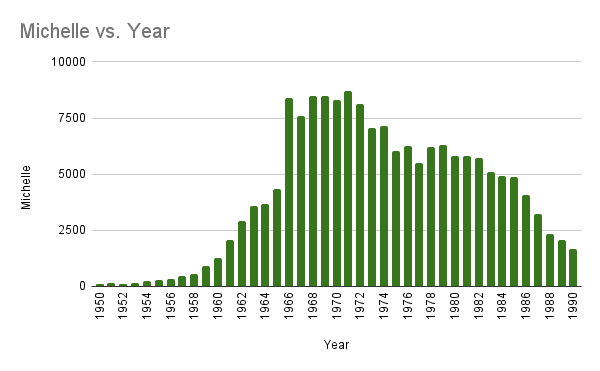
Registrations remained above 7,500 annually before gradually declining.
Tammy
Another case with a jump in registrations. I thought it might occur following the release of Debbie Reynolds 1957 hit from the film Tammy and the Bachelor.
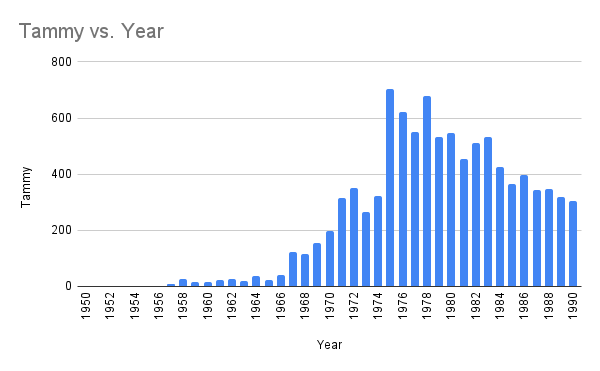
The name does not appear in FreeBMD until 1957, then there’s only a blip. The big jump in 1975 is attributed to the popularity of the song, “Stand by Your Man,” byTammy Wynette.
Future generations of family historians will still have the old conundrum of a succession Mary, Mary, Ann, Mary for pre-WW2. Afterwards, when the popular song has faded from memory, that will be replaced by the puzzle of “whyTammy”, and then by appreciation for the insight it gives into the parents’ cultural influences.
Interesting John. Personally I hated the way the world moved to take on names like Crystal, from the TV show of which I am too old to remember the name of. Cheers, BT
Names, names, names … just wait for the report next year and see how may girls (and boys) are named Taylor.
Yep – every single generation on every branch of my Beake family tree has John, Thomas, Robert, and William – with the occasional Henry thrown in! Every single one. And the girls were always Elizabeth, Mary, and Anne.
Variety in names in more recent times will help future genealogists!
I have a great Uncle whose second name was Decourcie (b. 1891). I wondered where it came from. Recently I found that his Uncle (b. 1848) and Cousin (b.1877) ( also bore the second name Decourcie. I haven’t found any instances further back but feel it must have some significance. I wonder if it had some significance to place or time in history. This line immigrated to Ontario, Canada from Kent/Sussex England in the 1840
Sounds to me like a surname that was carried on thru generations, especially if it shows up more than once. On my Banks line many subsequent generations ended up passing the name down as a middle name. My dad’s middle name was Banks, his mother’s middle name was Banks. Her mother’s surname was Banks.
I have met a young couple whose children have INVENTED names. Not sure how to spell them , never mind, ” What is it you said their names are? ” Variations in spelling of names we know, is one thing…
MAS