Weir(d?) Times at Library and Archives Canada

  • Consultation on Service
    LAC maintains communication with clients through various consultation and mechanisms to better understand its client base and their needs.
    – Services Consultation Committee has been inactive since 2024 and has not met recently.
    – 2025 Service Improvement Survey results were posted on 23 February 2026 linking to an extensive contractor report. The vast majority of clients expressed satisfaction with the quality of the interactions they have had in person with LAC staff. Opinions on online services were positive but less favourable. Two-thirds of current LAC clients pointed to genealogy and family history (67%) and Canada history and land (65%) as areas where LAC’s collections are of interest to them. Kudos to LAC for funding the survey.
    – Youth Advisory Council is documented in a webpage dated 12 December 2025. 10 people. age 16 – 25, served for 2025-26. The Council met four times, January — April 2026 with meeting summaries posted. While there’s good evidence of there being a genuine consultation opportunity, there’s only suggestive, not confirmed, evidence of lasting impact.
    Stakeholders Forum comprises 15 professional organizations that meet twice a year. The last reported meeting was Fall 2025. It featured presentations sharing highlights of activities currently underway within three organizations. While the Canadian Historical Association is a member, there is no representation from any genealogical or family history group, even though they represent two-thirds of LAC’s clients.


  • Newspapers
    Two decades ago LAC made a decision to reduce the resources it dedicated to newspapers.  Staff were let go. Today, on LAC’s Research Guides and Tools for Finding Newspapers, it states “Most of our newspapers are not digitized, so you will need to view them in person.” An exception is “Four Indigenous newspapers (that) have been digitized as part of LAC’s National Heritage Digitization Strategy.” That was achieived through earmarked external funding.
    Much of LAC’s legacy newspaper collection is on microfilm, available at the Ottawa location. A substantial part of that is open self-service access, although that will likely change with the move to Adisoke.  Unlike other countries newspaper initiatives, LAC remains in the microfilm age.


Military requests outstanding decreased by 8.5% in the three months. Government records requests outstanding increased by 12.7%.

Processing capacity for military and public servant files has scaled up dramatically over the year, meaning those seeking essential service records are experiencing better turnaround times.

General government archival requests receive a much smaller share of attention, creating frustrating bottlenecks for deep historical and lineage research.

Thousands of requests are still carried over from quarter to quarter, with some multi-year delays, guaranteeing that anyone investigating restricted historical collections will continue to face major obstacles accessing primary sources.


Ask AI: What is the maximum number of children a woman could have?

Before reading this, make your own assessment (guess).

20,30, 40, 50, 60, 70, 80, 90, 100, 100+?


I asked three AI services.

All referenced the woman most commonly credited with the highest number of children, Valentina Vassilyeva, the first wife of Feodor Vassilyev of Shuya, Russia. According to an 18th-century account, she supposedly had 69 children:

16 pairs of twins = 32
7 sets of triplets = 21
4 sets of quadruplets = 16
Total: 69 children
Across 27 pregnancies

Gemini (3.7 Flash)

  • Biological & Theoretical Limits (Single Pregnancies)

  • Fertile Window: Assuming an active reproductive lifespan of roughly 30 to 35 years (e.g., ages 15 to 45 or 50).

  • Gestation & Recovery: A full-term pregnancy lasts approximately 40 weeks (9 months), followed by postpartum recovery and the return of ovulation.

  • Maximum Singletons: If a woman becomes pregnant immediately after each birth with virtually no interval, the mathematical ceiling for single-child births is roughly 30 to 40 children over a lifetime. In practice, maternal depletion, physiological strain, and declining fertility after age 35 make reaching this number exceedingly rare.

Theoretical Maximum (Multiple Births & Technology)

  • Natural Multiples: A woman with a strong genetic predisposition to hyperovulation (releasing multiple eggs per cycle) who consistently carries twins, triplets, or quadruplets to viability can theoretically reach 60 to 75+ children, matching or slightly exceeding the historical record.

  • Genetic vs. Gestational Capacity: A woman’s ovaries contain roughly 300,000 to 400,000 eggs at puberty. With modern assisted reproductive technology (IVF, egg harvesting, and gestational surrogacy), a woman could theoretically have hundreds of genetic offspring, but her gestational capacity remains capped by time and human biology.

ChatGPT

What is biologically possible?

A woman who began having children very young and remained fertile into her late 40s could theoretically have 40 or more pregnancies, especially if pregnancies occurred almost continuously and some were twins or triplets.

For example, with:

  • first pregnancy at 15
  • last pregnancy at 50
  • roughly one pregnancy every 10–12 months
  • mostly single births

she might have 35–40 children.

But multiple births change the calculation dramatically. A woman having twins, triplets or quadruplets could theoretically exceed 50 children without an extraordinarily large number of pregnancies.

Claude (Sonnet 5, medium)

Biological upper limit

If you’re asking about a realistic ceiling based on biology rather than a historical record:

  • A woman is fertile for roughly 30+ years (teens to mid-40s, sometimes later).
  • Pregnancy plus recovery takes about a year per single birth if she wanted to maximize output, so in theory ~30–35 singleton pregnancies could fit into a fertile lifespan.
  • Multiples (twins, triplets, etc.) push the number of children higher without needing more pregnancies — this is exactly what happened in the Vassilyev case.
  • With extreme multiples (like the higher-order pregnancies enabled by fertility treatments, e.g. octuplets), a single pregnancy could theoretically add 6–8+ children, though survival rates drop sharply with very high-order multiples.

So in practice, the highest confirmed number is that ~69 figure, while a rough theoretical ceiling combining maximum pregnancies and multiples could run higher — but survivability and medical risk make astronomical numbers essentially impossible in real life.

BIFHSGO Conference Update

This year’s British Isles Family History Society (BIFHSGO) conference dives deep into the forces behind Scottish migration and emigration, offering expert speakers with invaluable insights and practical strategies to help trace family lines back to a Scottish homeland. Here’s the program for this year’s virtual conference.

The program,  themed Flittin’ Day: Forces That Moved our Scottish Ancestors will include the following speakers and topics:

Sir Tom Devine The puzzle of mass Scottish transatlantic emigration 1815 to 1914. Can it be convincingly resolved?
Professor Graeme Morton Industrial Scotland, Industrial Dundee: Following the immigrant workforce
Dr. Frances Wilkins The Songs that Stayed and the Songs that Were Taken Away: The Role of Music in the Lives of Scottish Migrants
Alison Spring Researching Urban Ancestors in Scotland
Morag Peers Crossing the Sea: Researching Scottish Ancestors
Professor Marjory Harper Religious Movements, Fragmented Communities and Contentious Clerics: Secession, Migration and Emigration in 19th-century Scotland
Chris Fleet Tracing Scottish Ancestors with Online Maps
Laura House Genealogy, the Information Ecosystem, and Our Technofuture

Additionally, Graeme Morton, Morag Peers, Marjory Harper and Frances Wilkins will take part in the Expert Connect Q and A session together with additional guest experts.

For more information, visit the conference website HERE.

This Week’s Online Genealogy Events

Choose from these selected free online events. All times are Eastern Time, unless otherwise noted. Registration may be required in advance—please check the links to avoid disappointment. For many more events, mainly in the U.S., visit https://conferencekeeper.org/virtual/ .

Tuesday, 18 August  2026

2:00 PM EDT – Ottawa Virtual Genealogy Drop-In, for OGS Ottawa Branch
https://ottawa.ogs.on.ca/events/virtual-genealogy-drop-in-2-2026-08-18/

2:30 PM EDT – Ship Manifests and Oaths of Allegiance: Finding the Origin
Stories of 19th Century Immigrant Families, by Jeremy Verdusco for Allen County Public Library Genealogy Center.
https://acpl.libnet.info/event/16670975

8:00 PM EDT – Supercharged Research: Working with AI Tools and Meeting Genealogical Standards, by David S. Ouimette for BCG (Board for Certification of Genealogists) / Legacy Family Tree Webinars. https://familytreewebinars.com/webinar/supercharged-research-working-with-ai-tools-and-meeting-genealogy-standards

Wednesday, 19 August 2026

2:00 PM EDT – DNA in Action 4 of 6: The DNA FAN Club, by Karen Stanbary for Legacy Family Tree Webinars. https://familytreewebinars.com/webinar/dna-in-action-4-of-6-the-dna-fan-club

Thursday, 20 August 2026

Friday, 21 August 2026

2:00 PM EDT – Migration Pathways Between Canada and the United States You Haven’t Explored, by Kathryn Lake Hogan for Legacy Family Tree Webinars (O Canada Series)
https://familytreewebinars.com/webinar/migration-pathways-between-canada-and-the-united-states-you-havent-considered

Saturday, 22 August 2026

Family Tree Magazine: September 2026

Briefly, the contents of this issue.

MARRIAGES: BEYOND THE OFFICIAL RECORD
David Annal explains why there may be more than one source of information about our ancestors’ marriages.

WHAT DID YOUR ANCESTORS DO IN WAR WEAPONS WEEK?
Discover the nationwide range of community events — held to raise funds for the machinery of war during WW2— with Janet Smith.

BOOK REVIEWS
The Secrets of Our DNA: How Genetics Has Changed the World, By Turi King.
How to Research your Second World War Ancestors, By Simon Fowler
Samuel Pepys in 50 Places and Objects, By Paul Kendall.

A PRACTICAL GUIDE TO DNA PAINTER
Donna Rutherford’s deep dive shows how to use 6 key tools from DNA Painter.

WHAT DID YOUR ANCESTORS DO IN THE INDUSTRIAL REVOLUTION?
The experts at Findmypast explain why this pivotal period offers an opportunity to discover how our ancestors lived — and worked.

FROM HOME TO HORIZON
Julie Johnson helps us understand the real person beyond the records, as she continues her Birth to Burial series.

POOR LAW SETTLEMENT DISPUTES
Nicola Waterfall examines the case of Edith Scully, a ‘pauper lunatic’, and the long drawn-out battle over her settlement.

RECORDING YOUR RESEARCH EFFECTIVELY
Dr Karen Cummings give us lots of useful advice on how to keep effective and robust research notes, and why this is crucial to our success as family historians.

BUILDING CONFIDENCE IN DNA TESTING
Karen Evans addresses some common concerns about the process, and tells us where we can learn more.

ANCESTRY Al TIPS
Discover the Ancestry Principles for Responsible Artificial Intelligence (Al) and learn how the developing Al features are helping to shed light on family stories.

SPOTLIGHT ON ..PHAROS TUTORS
Karen Cummings looks back at how Pharos Tutors started, how it has grown, and the celebrations that are taking place

Sunday Sundries: Maps and Weather

Miscellaneous items I found interesting this week.

GeoPuzzle – Arrange the pieces of the world!

Beyond the 15‑minute city: What really makes people want to walk

London, drawn, a sprawling AI-generated city rendered in the style of a classic SimCity map.

Reading Maps: Journeys from fiction drawn on the real world

Map tools for family history
Free tools that turn your research into a map you can share — built for genealogists, and for anyone trying to show where a story happened.

New targeted warnings for severe thunderstorms and tornadoes
Canada’s Meteorological Service, part of ECCC, is improving warnings for severe thunderstorms and tornadoes. The area alerted will now be much more precise;  you are much more likely to see dangerous weather. I experienced this on Monday when a tornado warning came on my mobile phone, but didn’t appear on The Weather Network TV channel. It became real for me when a major branch fell from a tree across my back fence and landed in my garden.

Elias Ashmole: A 17th-century weatherman?
As a former meteorologist, this article by Rebecca Rideal grabbed my attention. Even if weather history isn’t your thing, take a look at the posts on her Substack.

OGS to Increase Fees
The Ontario Genealogical Society Board has approved an increase in the annual fee by $12, which translates to a dollar per year for the 12 years fees remained at $63. There will be a general meeting to approve what most people would accept as a reasonable increase given the recent operating deficits.

Thanks to the following individuals for their comments and tips: Anonymous, Jane MacNamara, Julia, Gail, Glenn, Teresa, TONI, and Unknown.


Findmypast Weekly Update

Great Western Railway Company Staff Records
Now with 556,680 results covering staff of the Great Western Railway Company — “God’s Wonderful Railway” — founded in 1835. Drawn from The National Archives’ RAIL 264 series, these registers can include name, occupation, station, appointment and birth details, and last date of service, each with a transcript and often an image. Ideal for tracing clerks, firemen, stowers and other railway ancestors.

The Ellesmere Canal Company
Now with 9,928 results relating to the Ellesmere Canal Company, drawn from The National Archives’ RAIL 827 series, including shareholders’ records and company minutes. Records include names, appointment details, stations and occupations.

Derbyshire Early Census Returns, 1695–1863
2,075 results covering parishes such as Melbourne, Hollington, Offerton and Mackworth, published in cooperation with the Derbyshire Family History Society and the Family History Federation. Each transcript includes name, event date, place, county and household reference.

Scotland Monumental Inscriptions
This collection now has: 1,223,554 results, the largest of its kind online, compiled by societies including the Aberdeen & North East Scotland FHS, Caithness FHS and the Scottish Genealogy Society.

Newspapers

England

Publication Location Date Range Issues
Ashton Reporter Ashton-under-Lyne 1889 52
Bell’s Weekly Messenger London 1900 – 1904 261
Berks and Oxon Advertiser Wallingford 1960 – 1963 163
Bognor Regis Observer Bognor Regis 1877 – 1889 104
Bury Free Press Bury St Edmunds 1897 52
Chester Courant Chester 1830 52
County Express Stourbridge 1919 52
Cumberland Pacquet and Ware’s Whitehaven Advertiser Whitehaven 1774 11
Derby and Chesterfield Reporter Derby 1841 – 1930 273
Devizes and Wiltshire Gazette Devizes 1897 – 1913 156
Dewsbury Social-Democrat Dewsbury 1907 – 1909 25
Hastings and St Leonards Observer Hastings 2005 52
Kentish Express Ashford 1983 52
Lichfield Mercury Lichfield 2004 52
Macclesfield Express Macclesfield 2000 – 2001 105
Nation and The Athenaeum London 1907 – 1931 729
Northern Gardener Manchester 1890 52
Oxford University and City Herald Oxford 1885 52
Preston Herald Preston 1910 208
South Bucks Free Press High Wycombe 1889 52
Southern Times and Dorset County Herald Weymouth 1870 53
Sporting Times London 1869 46
St. Neots Advertiser St Neots 1904 – 1964 1,639
Tonbridge Free Press Tonbridge 1965 – 1966 105
Woodbridge Reporter Woodbridge 1934 – 1936 157
Yorkshireman Bradford 1890 – 1891 68

Scotland & Wales

Publication Location Date Range Issues
Forres Elgin and Nairn Gazette Forres, Scotland 1987 52
North Wales Times Denbigh, Wales 1911 – 1912 104
South Wales Daily News Cardiff, Wales 1913 308
Wishaw World Wishaw, Scotland 2000 – 2005 264

Ireland & International

Publication Location Date Range Issues
Connaught Telegraph Castlebar, Republic of Ireland 1847 – 1867 672
Limerick Reporter Limerick, Republic of Ireland 1882 – 1895 300
The Pilot Dublin, Republic of Ireland 1840 – 1844 780
Times of India Bombay, India 1906 – 1966 8,279


Good Reading in the Journal of One-Name Studies

As one of 88 Canadian members of the Guild of One-Name Studies I receive the quarterly Journal of One-Name Studies.  The full-colour July-September 2026 issue, brim-full of good information, just arrived in my mail-box.

As I don’t conduct a study, and can’t conveniently attend the in-person events like UK residents — 73% of the membership — the journal is my most valuable benefit.

Leaving aside the “ado”, here are the articles I found of interest :

The Private Life of a Family Bible. The story of a purloined treasure.

The Origin & Development of a Ricketts Paternal line:. Combines Y-chromosome DNA testing, parish records, and historical geography to trace a paternal lineage back to a single medieval founder.

Joseph Chicken, Businessman & Bigamist:.He abandoned his wife and two sons, emigrated to Australia and started a second family. Becoming wealthy, he eventually reconnected with his English relatives. I have Chicken ancestors from Cumberland where he is buried.

Book Review: Genealogy Methods & Techniques. Highly recommended by reviewer, and Guild Chair, Julie Goucher. Author Karen Cummings owns Pharos Tutors which was previously owned by Helen Osborn, author of Genealogy: Essential Research Methods.

Navigating the Future: Proceedings of the Annual Conference 2026. A collection of one-page summaries of presentations given at the Guild annual conference last April. Four papers were devoted principally to AI, “not because it was viewed as a solution to every problem, but because it is already becoming part of the everyday toolkit of family historians.”

DNA for your One-Name Study. The article ends with “The most consistent complaint I hear about DNA testing for genealogy is: “I wish I had done it sooner.”

Shepheard Families in South Devon. Canadian genealogist Wayne Shepheard does a deep dive into the statistics of his family surname and variants. Beware drawing conclusions from patchy data.

Like many genealogy organizations, Guild membership is declining, down 3.5% in the past year.

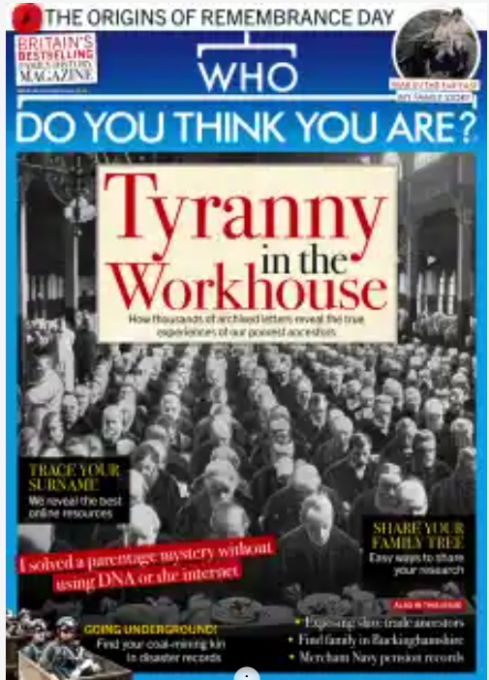
WDYTYA Magazine: September 2026

The three feature articles in this issue have:

Debbie Kennett, in Tales of the Unexpected, on how to spot the tell-tale signs of family secrets and how to sensitively research them further using DNA. Magazine editor Sarah Williams comments that a recent  episode of WDYTY on TV, that Debbie refers to, featuring Ruth Madeley’, was a stand-out. She recommends watching it on BBC iPlayer (not much help here).

Laura Berry on how she found out she is related to Prime Minister Mark Carney. 

Nicola Johnson reviewing the evolution of the trans-Atlantic experience for those travelling steerage, later rebranded as third-class.

 Elsewhere in the issue, Jonathan Scott continues his series with articles on  tracing Caribbean heritage, and genealogical resources for Lincolnshire.

Ancestry Adds Malta BMDs

When searching for an elusive person in your family tree, you greet each new database with hope. Mine, for my first cousin twice removed, were dashed. Nothing like his name, variously spelled, is found in this collection, new to Ancestry, of 8,807,213 Maltese BMD  records.
Dated between 1500 and 1983, they come via The National Archives of Malta, in Rabat. The collection has many records written in Italian, also in Maltese, Latin, and English.
Most, if not all, indexes or transcriptions are linked to images of the original.

Weir(d?) Times at Library and Archives Canada

  • In March 2022 an ATIP request was made for files dating from 1945 to 1953 classified as Government of Canada archival records. As of 31 March, four years later, it was one of 2,186 records so classified which were late.  While the backlog of requests for Records of former Canadian Armed Forces members and former public servants saw a substantial decrease in the year, that for Government of Canada archival records has barely moved. Does the Federal Government believe that is acceptable performance? Is the problem a deficiency in management of the program, a lack of resources, a mix, or something else? In either case, it’s the responsibility of the Carney government to address delays that make a mockery of the legislation.
  • Last week, in a post that got substantial attention, I reported that “An order for publications (directories) I placed on 24 July was “Not ready for pick up” 11 days later.” It turns out the problem was a deficiency in reporting through the online system. A piece of paper had been left in the “R” shelf at LAC informing that the years requested are not in the collection. Are we expected to hang around 395 Wellington waiting for a piece of paper to appear? If there’s an online system to communicate to clients about the status of orders, why not use it for prompt notification?
  • Maps are documentary heritage. Once upon a time, LAC had a map collection. It probably still does, but it’s so neglected as to be practically invisible. There isn’t even an entry for Maps in LAC’s A to Z research guides and tools facility.  It’s not as if the research guides are being neglected. 2SLGBTQIA+ related resources research guide was recently added.
  • It’s not just LAC.  Cuts are being made to heritage-memory institutions at the local and provincial levels as well as federal. A grassroots group of archivists, historians, genealogists, museums, and gallery workers is formed — the Canadian Cultural Heritage Advocacy Committee . If you’re concerned, sign up at the website for their email newsletter.
  • There’s an addition to the LAC Collection at the Internet Archive Canada, an 8-page poem “Lines on the massacre of Oszmiana”?  Should there be a CanCon requirement?

This Week’s Online Genealogy Events

Choose from these selected free online events. All times are Eastern Time, unless otherwise noted. Registration may be required in advance—please check the links to avoid disappointment. For many more events, mainly in the U.S., visit https://conferencekeeper.org/virtual/

Tuesday, 11 August

2:00 PM: Using the Scandinavian Church Records on MyHeritage.com, by Jenny Hansen for Legacy Family Tree Webinars.
https://familytreewebinars.com/webinar/using-the-scandinavian-church-records-on-myheritage-com

2:30 PM: What Can DNA Really Tell You? DNA and Genealogy Basics, by Collette Fenlason for Allen County Public Library Genealogy Center.
https://acpl.libnet.info/event/16670925

Wednesday, 12 August

2:00 PM: Citations Made Simple: Strategies for Every Genealogist, by Lisa Stokes for Legacy Family Tree Webinars.
https://familytreewebinars.com/webinar/citations-made-simple-strategies-for-every-genealogist

Thursday 13 August – Saturday 15 August

https://childthemewp.com