

-
The Budget
LAC is mentioned twice in the 5 November budget document.1. “Budget 2026 proposes to provide $783.1 million over five years, on a cash
basis, starting in 2026-27, to support Canada’s national museums, the
National Battlefields Commission, the National Arts Centre, and Library and Archives Canada. This investment will help repair and renew aging facilities, protect national collections, and sustain the exhibitions, performances, and services that connect Canadians to our history and culture.”
2. A table on Policy actions taken since the Spring Economic Update 2026 shows LAC as allocated an additional $ 1 million each year from 2027-2028 onward.
The last time LAC was mentioned in the budget document was in 2022 when ” $25 million over three years, starting in 2022-23, to Library and Archives Canada to support the digitization of millions of documents relating to the federal Indian Day School System”
-
LAC Departmental Results Report 2025–2026
Performance Indicator Comparison (2024–25 vs. 2025–26)
| Indicator | Target | 2024–25 Actual | 2025–26 Actual | Trend & Status |
| Federal institutions transferring records | 10% | 13.14% | 21.6% | Improved (Target Met) |
| Increase in digital published titles | 25% | 40.4% | 13% | Stabilized (Below 25% benchmark, though LAC counts as met) |
| Target acquisition areas covered | 75% | 96% | 96% | Unchanged (Target Met) |
| Government records processed in standard | 60% | 61.2% | 68% | Improved (Target Met) |
| Published heritage processed in standard | 83% | 93% | 89% | Declined due to budget cuts (Target Met) |
| Private archives processed in standard | 75% | 91% | 98% | Improved (Target Met) |
| Analog preservation facility standards | 75% | 57% | 64.25% | Improved, but Target Missed |
| Digital material preserved (Cumulative) | 18,871 TB | 17,371 TB | 19,132 TB | Improved (Target Met) |
| Images digitized for access | 6.5 M | 10 M | 11.4 M | Improved (Target Surpassed) |
| Unique website/online visitors | 3 M | 2.9 M | 5.7 M | Improved; moved from missed to Target Met |
| Onsite and remote service transactions | 60,000 | 50,606 | 83,658 | Improved; moved from missed to Target Met |
| ATIP requests processed vs. total active | 70% | 66% | 69% | Improved, but Target Missed |
| Exhibition and event attendance | 150,000 | 161,992 | 222,193 | Improved (Target Met) |
| Collection items loaned for exhibitions | 75 | 88 | 44 | Declined; fell from met to Target Missed |
| DHCP recipients achieving results | 90% | 91% | 100% | Improved (Target Met; program now cancelled) |
What Has Improved
-
Digitization and Researcher Tools: Building on the 10 million images digitized in 2024–25, LAC reached 11.4 million images in 2025–26. It concluded the massive Federal Indian Day Schools digitization initiative and secured a $5 million philanthropic donation via the LAC Foundation to accelerate digitizing Second World War collections. For researchers, LAC finished migrating its last legacy databases into Collection Search (now indexing more than 70 million records), refined census search functionality to automatically link sub-district names with district numbers, and separated First World War personnel files from general war records.
-
AI-Assisted Transcription (Transkribus): LAC completed its first AI pilot using Transkribus for handwritten text recognition on Orders-in-Council registers, generating 55,000 new searchable descriptions. It is now applying this same workflow to census records and Second World War image indexes, although better AI options may now exist than Transkribus.
-
Client Service & Web Traffic Rebound: After stagnating in 2024–25 (when both website visits and service transactions missed their targets), online visitors nearly doubled from 2.9 million to 5.7 million, and service transactions across Ottawa, Halifax, Winnipeg, and Vancouver jumped by 65%—from 50,606 to 83,658.
-
Proactive Declassification and Opening: To bypass the ATIP bottleneck, LAC reviewed and proactively opened more than 12 million pages of archival government records, uploaded 7,083 previously released ATIP packages (nearly 980,000 pages) for self-service download, and lowered security classifications on more than 200,000 pages of classified government files.
-
Born-Digital Transfers & High-Profile Fonds: LAC completed its first direct digital transfer pilot with the Department of National Defence into its Digital Asset Management System (DAMS), cutting processing times from months to weeks. It also completed processing the Stephen J. Harper fonds (its largest digital acquisition ever, including 400,000 digital records and over 1 million photos) and major portions of the Canadian National Railway (CN) fonds.
What Hasn’t Improved (Or Slipped)
-
ATIP Still Falls Short of Target: Processing crept up from 66% in 2024–25 to 69% in 2025–26—tantalizingly close to the 70% benchmark, yet still failing to meet it for another consecutive year. While the overdue backlog proportion dropped from 71% to 55% through better triage, more than half of active requests remain overdue. Why is a target short of legislative requirements satisfactory?
-
Analog Facility Environmental Standards: This remains the sole blemish under Core Responsibility 1. While the metric rose from 57% to 64.25% of total vault volume ($m^3$), it remains well short of the 75% target. LAC’s three purpose-built facilities in Gatineau hit 90% compliance, meaning older storage sites (such as the Renfrew facility, currently undergoing roof and electrical replacements) continue to drag down the average and force LAC to relocate vulnerable items.
-
Exhibition Loans Cut in Half: After loaning 88 items in 2024–25 (beating the target of 75), loans dropped to just 44 items in 2025–26, which LAC attributes to fewer external requests.
-
Published Heritage Processing Speed & Digital Deposits: While still above the 83% standard, timely cataloguing of published heritage slipped for the second year in a row (from 94% in 2023–24 to 93% in 2024–25, down to 89% in 2025–26). The Report explicitly notes this drop is the direct result of budget and resource reductions. Meanwhile, the annual growth rate of digital legal deposits cooled from 40.4% to 13%, missing the 25% growth target.
-
Ādisōke Opening Delays: While construction progressed to roughly 85% completion by spring 2026 and internal programming plans (such as the joint Family History Centre with OPL) are taking shape, the report formally notes the City of Ottawa’s announcement that the facility’s opening is delayed.
What Remain Major Concerns
-
Steep Budget and Staffing Cuts Ahead: The financial and human resources tables reveal a severe fiscal cliff driven by the sunsetting of temporary initiatives, Budget 2023 Refocusing Government Spending targets, and Budget 2025 Comprehensive Expenditure Review reductions.
-
Total Spending dropped from $212.4M (2024–25) to $194.5M (2025–26), and is projected to fall to $129.9M by 2028–29—an early 39% reduction from 2024–25 levels.
-
Core Responsibility 2 (Access) Spending takes the hardest hit on paper, dropping from $83.5M in 2024–25 to $69.3M in 2025–26, and plunging to $27.8M by 2028–29 (though footnotes clarify that permanent future ATIP funding is not yet factored into those out-year tables).
-
Workforce (FTEs) dropped from 1,201 in 2024–25 to 1,061 in 2025–26, with indeterminate and term reductions projected to shrink staff to 707 FTEs by 2028–29 (with Access staff cut more than half on paper, from 460 in 2024–25 to 192 in 2028–29).
-
-
Termination of the Documentary Heritage Communities Program (DHCP): Even though DHCP achieved a 100% success rate in 2025–26 across 28 evaluated reports, LAC announced it is discontinuing the program entirely to save costs. Combined with the sunsetting of the Listen, Hear Our Voices Indigenous heritage grant program in March 2025, local archives, historical societies, and genealogical groups across Canada have lost vital federal grant support.
-
Planned Reductions in ATIP and Proactive Access: Despite ATIP still missing its 70% compliance target, LAC announced a “gradual reduction in ATIP and Proactive Access activities” and began shedding ATIP term employees in 2025–26 to live within permanent baseline funding. Scaling back proactive opening and ATIP staff as backlogs begin to recede risks reversing hard-won gains for researchers. Note the comment that anticipated “permanent future ATIP funding” is not yet accounted for.
- Future Funding — 88 percent of the cut is allocated to providing access to documentary heritage.
Table 12 shows that between 2026-27 and 2028-29, LAC will see a $55 million budget cut.


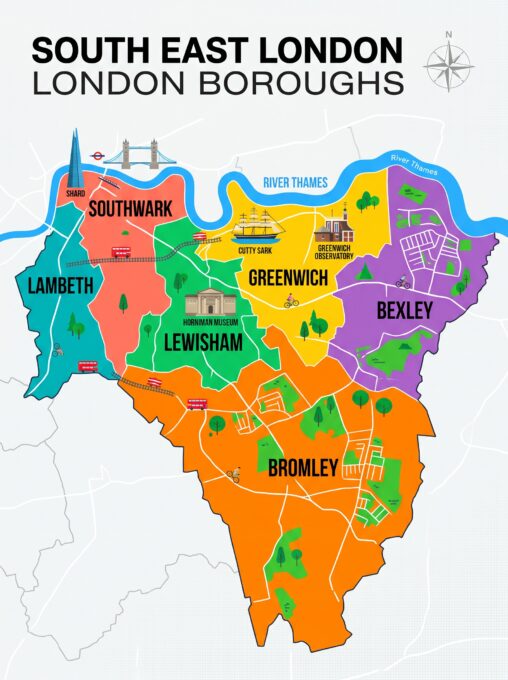 Bexley, Bromley, Greenwich, Lambeth, Lewisham, and Southwark.
 “GAIA (Genealogy AI Agent) plans and conducts research, searches billions of historical records on MyHeritage and external online sources, and presents evidence-backed findings to help users achieve breakthroughs in their research.” Check out the extended MyHeritage blog post