Before reading this, make your own assessment (guess).
20,30, 40, 50, 60, 70, 80, 90, 100, 100+?
I asked three AI services.
All referenced the woman most commonly credited with the highest number of children, Valentina Vassilyeva, the first wife of Feodor Vassilyev of Shuya, Russia. According to an 18th-century account, she supposedly had 69 children:
16 pairs of twins = 32
7 sets of triplets = 21
4 sets of quadruplets = 16
Total: 69 children
Across 27 pregnancies
Gemini (3.7 Flash)
-
Fertile Window: Assuming an active reproductive lifespan of roughly 30 to 35 years (e.g., ages 15 to 45 or 50).
-
Gestation & Recovery: A full-term pregnancy lasts approximately 40 weeks (9 months), followed by postpartum recovery and the return of ovulation.
-
Maximum Singletons: If a woman becomes pregnant immediately after each birth with virtually no interval, the mathematical ceiling for single-child births is roughly 30 to 40 children over a lifetime. In practice, maternal depletion, physiological strain, and declining fertility after age 35 make reaching this number exceedingly rare.
Theoretical Maximum (Multiple Births & Technology)
-
Natural Multiples: A woman with a strong genetic predisposition to hyperovulation (releasing multiple eggs per cycle) who consistently carries twins, triplets, or quadruplets to viability can theoretically reach 60 to 75+ children, matching or slightly exceeding the historical record.
-
Genetic vs. Gestational Capacity: A woman’s ovaries contain roughly 300,000 to 400,000 eggs at puberty. With modern assisted reproductive technology (IVF, egg harvesting, and gestational surrogacy), a woman could theoretically have hundreds of genetic offspring, but her gestational capacity remains capped by time and human biology.
ChatGPT
What is biologically possible?
A woman who began having children very young and remained fertile into her late 40s could theoretically have 40 or more pregnancies, especially if pregnancies occurred almost continuously and some were twins or triplets.
For example, with:
- first pregnancy at 15
- last pregnancy at 50
- roughly one pregnancy every 10–12 months
- mostly single births
she might have 35–40 children.
But multiple births change the calculation dramatically. A woman having twins, triplets or quadruplets could theoretically exceed 50 children without an extraordinarily large number of pregnancies.
Claude (Sonnet 5, medium)
Biological upper limit
If you’re asking about a realistic ceiling based on biology rather than a historical record:
- A woman is fertile for roughly 30+ years (teens to mid-40s, sometimes later).
- Pregnancy plus recovery takes about a year per single birth if she wanted to maximize output, so in theory ~30–35 singleton pregnancies could fit into a fertile lifespan.
- Multiples (twins, triplets, etc.) push the number of children higher without needing more pregnancies — this is exactly what happened in the Vassilyev case.
- With extreme multiples (like the higher-order pregnancies enabled by fertility treatments, e.g. octuplets), a single pregnancy could theoretically add 6–8+ children, though survival rates drop sharply with very high-order multiples.
So in practice, the highest confirmed number is that ~69 figure, while a rough theoretical ceiling combining maximum pregnancies and multiples could run higher — but survivability and medical risk make astronomical numbers essentially impossible in real life.

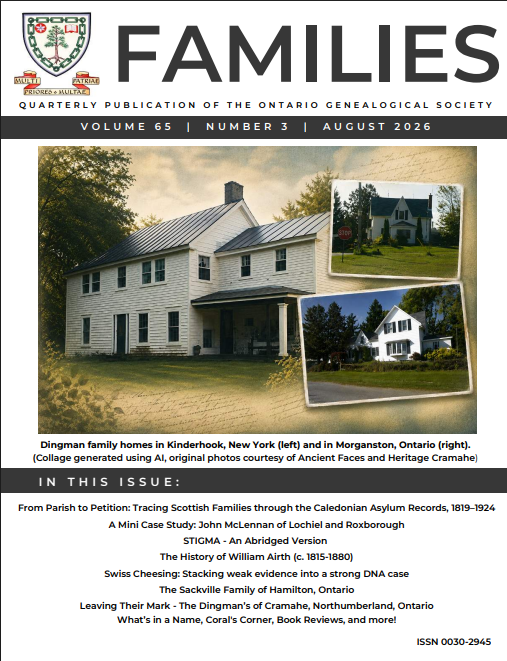 Volume 65, Number 3 of the OGS Quarterly publication is online for members. Contents are:
 Many record collections are too small and niche to attract the interest of the large genealogy companies, but none-the-less valuable. Often you’ll find them in the UK at local archives, county record offices and museums. It’s good practice to check those where you have ancestry periodically.
 MyHeritage has launched Y-DNA results that help users explore their direct paternal line based, in most cases, on existing MyHeritage DNA data, with no new test required.
 This year’s British Isles Family History Society (BIFHSGO) conference dives deep into the forces behind Scottish migration and emigration, offering expert speakers with invaluable insights and practical strategies to help trace family lines back to a Scottish homeland. Here’s