

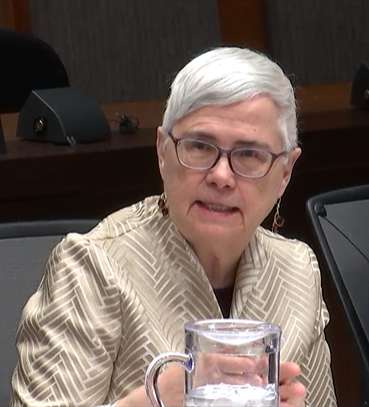
 On 21 April, Librarian and Archivist of Canada, Leslie Weir, was a witness before the House of Commons Standing Committee on Government Operations and Estimates. Assisting her were Jennifer Schofield, Assistant Deputy Minister, Collections Sector, who responded with detail to several questions, and Jean Deschamps, Acting Assistant Deputy Minister, Corporate Services Sector, and Chief Financial Officer.
Much of the questioning focused on LAC’s decision to allocate a major part of its funding cuts to the Access to Information activity, particularly staff cuts. LAC does not meet the legal requirement 20% of the time in responding to ATIP requests.
It was noted that during COVID, staff were unable to access required records, resulting in a growing backlog. In the past year, it has been cut in half. MPs were concerned that the rate of progress would not be sustained with fewer staff.
Part of the information given was that a large part of the requests are for military files related to the Second World War. A new policy, that files for individuals born 110 years ago will no longer be reviewed. should help reduce the backlog. That applies to 30% of the files today, and 54% by 2030.
However, I heard no commitment to digitize those files and make them freely available for online self-service, cutting the human out of the loop in the same way as for earlier military files.
It was refreshing to see LAC managers being asked probing questions, not only from opposition members.
A video of the hearing, which runs for about 50 minutes, is at https://parlvu.parl.gc.ca/Harmony/en/PowerBrowser/PowerBrowserV2?fk=13449931
•
The changes at the LAC have been really discouraging in the last 6 years. The layers of rules and regulations to allow public access to public records is not how a free society operates. The LAC belongs to Canadian citizens and is fully funded by them.
I have a number of records that i was in the process of donating to the LAC, but i have changed my mind. Here is a direct quote:
“it may be important to consider whether any access restrictions are necessary.”. Why? The records in question are 50 years old. I could put them on facebook if i wanted to and no one would object.
Thanks for this. It is so difficult now with social media coverage of all types to get reliable details of government processes so I appreciate this posting.