
Links of Interest

Today I’m recommending you bookmark the Links of Interest page at Ken MacKinlay’s Family Tree Knots webpage. He just verified all the links and updated with additional categories

The main body covers:

  • Research and family tree sites — Ancestry, FamilySearch, Findmypast, MyHeritage, Genes Reunited, WikiTree, and others.
  • Canada — Library and Archives Canada (including censuses, military history, Home Children, parish records, and the Federal Divorce Index), the Canadian Research Knowledge Network (Canadiana and Héritage), provincial archives from Newfoundland to Yukon, vital statistics agencies, genealogical societies for every province, Canadian law resources (CanLII, Osgoode Digital Commons, BC Historical Statutes), and miscellaneous collections including denominational archives for Baptist, Mennonite, Presbyterian, Quaker, and United Church records.
  • British Isles — national archives and general resources for England, Wales, Scotland, Ireland, and Northern Ireland, including FreeBMD, FreeReg, ScotlandsPeople, IrishGenealogy.ie, the Virtual Record Treasury of Ireland, and the Ulster Historical Foundation.
  • DNA — testing services (AncestryDNA, 23andMe, FamilyTreeDNA, MyHeritage DNA, Living DNA) and analysis tools (DNA Painter, GEDmatch, Shared cM Project, ISOGG).
  • Education and certification — Legacy Family Tree Webinars, the Board for Certification of Genealogists, the Association of Professional Genealogists, and university-based genealogy programs.
  • Maps — historical county maps for Canada and the U.S., Ontario-specific mapping tools, the David Rumsey Map Collection, and the National Library of Scotland map images.
  • Newspapers — archives covering Canada (including Ontario county-level collections), the UK, Ireland, Australia, New Zealand, and the U.S., plus the Newspaper Finder directory.
  • Obituaries and cemeteries — Find a Grave, Commonwealth War Graves Commission, Canadian Headstones, the National RCMP Grave Discovery Database, and the Ryerson Index for Australia.
  • Passenger and ship lists — Bremen Passenger Lists, the Immigrant Ships Transcribers Guild, Lloyd’s Register of Ships, and Library and Archives Canada immigration resources.
  • Books — Google Books, HathiTrust, Internet Archive, WorldCat, and Evidence Explained.
  • International resources — covering Belgium, Sweden, Italy, the Netherlands, Germany, Australia, New Zealand, and the U.S.
  • Genealogy blogs — including Ken’s own Family Tree Knots, my Anglo-Celtic Connections, Scottish GENES, Genealogy à la carte, and Past Presence.

There’s more of the solid information and advice Ken is known for at his website;



Sunday Sundries

Miscellaneous items I found interesting this week.

Keith Hanton RIP
Prominent in the Ottawa Branch of OGS, enthusiastic researcher of his Irish ancestry.
https://www.arbormemorial.ca/en/kelly-barrhaven/obituaries/richard-keith-hanton/160432.html

Misinformation
According to StatsCan, in 2025, 80% of Canadians reported seeing news or information on the Internet that they suspected was misleading, false, or inaccurate at least once a month.

An update to this French genealogy website, which your browser can likely translate, includes an interesting looking article I haven’t yet exploted “A new free handwriting transcription tool powered by AI”

Major recent new and updated British additions to newspapers.com

Publication Date Range Pages Added
St. Albans, Harpenden, Welwyn Garden City, Hatfield Review (NEW) 1973–1981 18,397
The Montgomery County Times and Shropshire and Mid-Wales Advertiser (NEW) 1917–1951 9,871
Great Yarmouth Mercury (UPDATED) 1934–2024 96,252

Draw freehand shapes directly onto the map to estimate the area and population within any custom area.

Thanks to the following individuals for their comments and tips:  Anonymous, Brenda Turner, Christine Jackson, Gail, Julia, Michael More, Teresa, and Unknown.

Findmypast Weekly Update: Ireland

Ireland, Londonderry (Derry) & Armagh, Absent Voters Lists, 1918 adds 7,891 records compiled in the aftermath of the First World War, listing those who were away from their home address — often serving overseas — at the time of the 1918 electoral register. As well as confirming a man’s existence and address, these records provide a pointer to military service.

Ireland, Londonderry (Derry), Freemen Records, 1604–1963 offers 6,865 records spanning three and a half centuries. Freedom of the city was typically granted to the sons and apprentices of existing freemen, or by special honour, making these records useful for tracing family and occupational connections across many generations in the Derry area.

Newspapers

This week’s update adds 302,967 pages across six new titles and updates to 31 existing ones.  A notable addition is the Dublin Journal, 4,988 pages for
1782-1784, 1792-1793, 1796, 1798-1799, 1804-1816, 1820-1821, 1823-1824.

New Titles

Title Date Range Pages
Nursing Times 1905–1919 29,316
The Crescent 1896–1908 10,240
Voice of the People 1848 64
Musical Transcript 1853–1854 516
Maldon Express 1873–1932 1,242
Huddersfield Boro’ Advertiser 1913–1942 4,968

Updated Titles with Over 10,000 Pages Added

Title Date Range Pages
Field 1912–1920 32,994
Dundee Evening Telegraph 1990–2005 32,186
Reading Evening Post 2001–2002 31,682
Coventry Evening Telegraph 2005 25,258
Cambridge Daily News 2004 21,780
Crawley News 2003–2005 19,414
Broughty Ferry Guide and Advertiser 1994–2005 16,536
The Queen 1875–1885 15,078
Ampthill & District News 1912–1943 12,710

Ancestry adds Edinburgh, Scotland, Poor Law Records, 1817-1852

This new collection contains 38,959 records from government poorhouses in Edinburgh. It covers:

The transcription has provision for: Name, Marital Status, Age, Birth Date, Residence Date, Residence Place, Poor Law Union, Death Date. The linked original register image may show additional information, like Profession.

If you are interested in this area, take some time to browse. You may find additional information on the workhouse regime

Breakfast
For each Pauper one English Pint of Porridge, made with four Ounces of Oat Meal — 1/2 Pint of Milk or Beer, and One Ounce of Salt for each person per day
(If you had ordered a pint in a Scottish tavern in the 1700s, you would have received a much larger serving. The traditional Scots pint—often called a joug—remained in use until roughly 1826.)

Dinner
One Pint of Broth made with two Ounces of Barley, — Cabbage and Greens in proportion — with Ox heads.
Fine Bread, one loaf of 8 ounces.

Supper
To consist of the same quantity of Meal, Milk or Beer as the Breakfast.


TheGenealogist Releases Pre-WWI Survey Records for Devon

If your family roots stretch into Devon, there’s welcome news from TheGenealogist. The site has just released the Lloyd George Domesday Survey for Devon, building the coverage.

The survey, formally known as the 1910 Valuation Office Survey, was the Edwardian government’s attempt to record every parcel of land and property in England and Wales following the Finance Act of 1910. For each property, surveyors noted the owner, occupier, a description of the building or land, its use, and assessed value — a granular snapshot of the country on the eve of the First World War.

The Devon release covers 352,478 people and organisations, linked to more than 2,500 square miles of period mapping through TheGenealogist’s MapExplorer™ tool. Rather than finding an ancestor listed against an address and being left to guess where that stood, you can plot the actual property on a historic map and compare it with the landscape today.

Devon joins the counties of Bedfordshire, Berkshire, Buckinghamshire, Cambridgeshire, Dorset, Essex, Hampshire, Hertfordshire, Huntingdonshire, Kent, Middlesex, Northamptonshire, Oxfordshire, Surrey, Sussex and Wiltshire in this collection unique to TheGenealogist.

Find out more at thegenealogist.co.uk/lloyd-george-domesday.

MyHeritage adds United States, Incoming Passenger Lists from Canada, 1895-1957

On 12 May, MyHeritage added United States, Incoming Passenger Lists from Canada, 1895–1957 to its platform. The collection’s 5.2 million records typically include the passenger’s name, date and place of birth, last residence, departure point, and date and place of arrival, each linked to an image of the original document.
Where does the data actually come from?

One frustration with MyHeritage is that it rarely tells you the original source of a collection. To illustrate, take John D’Arcy Northwood, who arrived in Vancouver from Manila on 23 May 1934. MyHeritage’s record for Northwood gives his birthplace (Wolverhampton, England), last residence (Honolulu), departure point (Manila), and arrival (Vancouver, 23 May 1934), but no clue as to where the underlying record is held.

I’m guessing MyHeritage got it from FamilySearch, which holds United States, Border Crossings from Canada to United States, 1895–1956. FamilySearch is transparent about its sourcing: it explains that the records derive from various NARA microfilm publications, specifically Records of the Immigration and Naturalization Service, RG 85 (National Archives and Records Administration).

Ancestry goes further still. Its corresponding collection, U.S., Border Crossings from Canada to U.S., 1895–1960, not only identifies the originating NARA record group (RG 85, Series M1465) but also links to a full breakdown of the document types included, in this case, manifests of passengers arriving through Canadian Pacific ports, held at the National Archives in Washington, DC.

All three platforms draw on the same underlying records. But if you need to cite your source properly, or want to understand what you’re actually looking at, FamilySearch and Ancestry both give you considerably more to work with than MyHeritage.

The Case for a Hacker-in-Residence at LAC

This is a guest post, composed with the aid of Claude Sonnet 4.6.

The LAC Creator in Residence initiative has already proven its worth. Eric Chen’s murals drew on Chinese immigration records to produce works of cultural weight. Alexane Drolet promises to make history feel urgent and alive for a new generation. They speak to audiences through finished art.

But there is another kind of resident LAC could invite: one whose output looks less like a mural and more like a key. Not a key to one door, but a skeleton key that anyone can pick up and use.

What is a hacker?

Not a cybercriminal. In the tradition of digital humanities, a hacker is someone who takes systems apart to understand them and reassembles them in ways their designers never imagined. A hacker looks at a digitized archive and asks: What could I build with this?

The model already exists. Australian historian Tim Sherratt has spent years turning the collections of galleries, libraries, archives, and museums into playgrounds for researchers and curious minds. His GLAM Workbench is a freely available collection of notebooks, visualizations, and tutorials that let anyone harvest data from archival collections, mine newspaper archives, and conduct analysis that would once have taken a team of scholars years. He has made the collection radically more useful, not by telling one story, but by enabling thousands. AI enhances the opportunity.

The archive is not just a place to visit. It is a dataset waiting to be explored, if only someone would build the door.

What a LAC Hacker-in-Residence could build

One skilled resident, embedded for eight months, could produce tools that compound in value for decades:

Potential projects

  • Open notebooks for exploring census records, immigration data, and electoral histories
  • Visualizations of demographic and geographic shifts drawn from existing digitized holdings
  • Tutorials that make APIs genuinely accessible to researchers outside major universities
  • Large-scale name indexing across under-explored archival series, surfacing individuals invisible in traditional finding aids
  • Tools for connecting records across collections, linking military files with census and immigration data

This is not a critique of what a creator brings to the institution. But where a creator like Eric Chen makes you feel the weight of the Chinese Exclusion Act, a hacker could build the tools that let a researcher count and map how many families were separated. The feeling and the data are both necessary. They reinforce each other.

The creator tells a story. The hacker builds a stage on which many stories can be told.

Tools as radical access

LAC’s mandate is to make Canada’s documentary heritage accessible. Right now, much of that collection is technically accessible but practically inaccessible, sitting behind interfaces not designed with researchers or educators in mind.

A hacker’s output lives in a repository. A well-built notebook doesn’t stop being useful when the residency ends. It gets used, adapted, and extended for years by genealogists, teachers, journalists, and graduate students who can’t afford database subscriptions.

Canadian digital infrastructure for archival research lags behind comparable institutions in the UK, Australia, and the United States. LAC has the collections to compete. It needs the people to unlock them. A Hacker-in-Residence would signal that LAC sees its users not just as visitors, but as potential builders, and that it is ready to give one gifted, technically literate person the time and trust to make that possible.

The collections are extraordinary. Now build the tools to prove it.

Technical Problems at Canadiana

I’ve been trying to access Canadiana.ca to find out what’s new, only to be greeted by “This service is unavailable at this time. We apologize for the inconvenience.”

If instead you go directly to https://www.crkn-rcdr.ca/en/about-canadiana-collections, then click on Search the Canadiana Collection, you’ll read “As of May 8, 2026, the Canadiana and Héritage websites are experiencing intermittent outages and image loading issues. CRKN staff are investigating a solution. For more information, please visit our System Status page.”

Exploring further reveals that no new items have been added to the Canadiana or Héritage collections in the past month.

Ancestry adds records for Malta

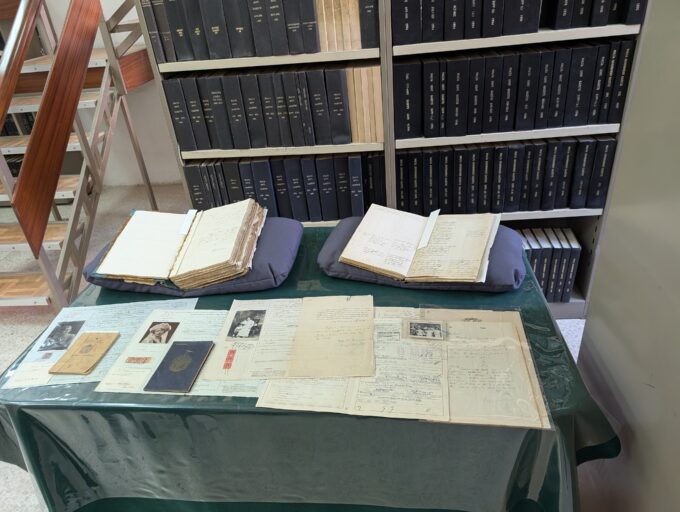
Last year, on holiday on the Mediterranean island of Malta, I had the privilege of visiting the National Archives in Rabat. Three of us from Ottawa, courtesy of a connection through Canada’s former Librarian and Archivist, Ian Wilson, were given a conducted tour. They laid out some particularly significant documents.

Along the way, it was mentioned that they had an agreement with Ancestry to publish some of their records. I’ve been waiting for them to appear.

On Tuesday, Ancestry released Malta Heraldry, 1500-2000 (in Italian) with 11,029 records. When I tried the link from the catalogue, I got the message “We’re sorry, this page is no longer available”, which, from past experience, means the data is being uploaded.

Although the island is small, Ottawa is nine times larger; they have similar populations. The Malta Archives, housed in a former hospital known as Santo Spirito, is over 650 years old, with records of its operation dating back to at least 1372.

The Archives holdings may be searched through https://www.archivesportaleurope.net/

FamilySearch vs Ancestry

On Monday, FamilySearch released an updated YouTube video titled FamilySearch vs Ancestry: Which Should Beginners REALLY Start With in 2026? Predictably, and perhaps unsurprisingly given that the video comes from FamilySearch themselves, they recommend their own platform — though to their credit, the endorsement is not entirely without qualification.

CORRECTION: Chad R. Milliner from FamilySearch Ancestry informs that the authors of the video, Family Tree Support, are NOT part of FamilySearch. My apologies.

However, the more fundamental issue is that the question itself is the wrong one to be asking in the first place.

Before a beginner even considers which online platform to use, they need to establish a solid foundation for their research — and that foundation cannot be built by an algorithm or a database. It must come from the researcher themselves. This means starting with what you already know: your own memories, family stories, and personal knowledge of relatives both living and deceased.

The next step is to gather and carefully examine family documents. These might include copies of official certificates — birth, marriage, and death records — as well as old letters, diaries, photographs, immigration papers, wills, and any other paperwork passed down through the family. Such primary sources are invaluable, as they provide concrete, contemporaneous evidence that no online tree can replicate.

Equally important is the human element. Talking to family members, relatives, and family friends — particularly older generations who may hold living memories of people and events long past — can yield information that simply does not exist anywhere online. These conversations should be treated as research interviews, with notes taken carefully and stories recorded wherever possible. Always bear in mind the fragility of human memory.

Only once this groundwork has been laid does it make sense to turn to online platforms like FamilySearch or Ancestry. At that point, the beginner researcher will be far better equipped to evaluate what they find, spot errors, and build on a reliable base, reducing the risk of accepting whatever an online family tree or hint suggests.

This Week’s Online Genealogy Events

Choose from these selected free online events. All times are Eastern Time, unless otherwise noted. Registration may be required in advance—please check the links to avoid disappointment. For many more events, mainly in the U.S., visit https://conferencekeeper.org/virtual/

Tuesday, 12 May

Wednesday, 13 May

Thursday, 14 May

Friday, 15 May

Saturday, 16 May

https://childthemewp.com