
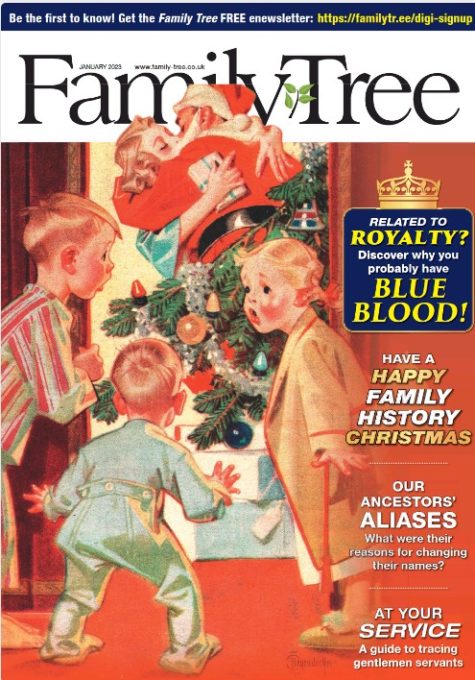
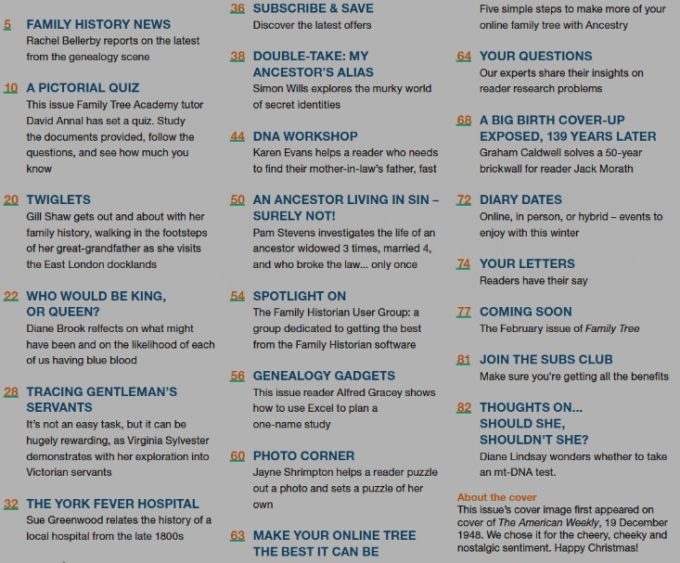
 I often feel like I’m shortchanging the editors and contributors in listing only my highlights of magazine issues. There’s content on every page of interest to someone, maybe you. But not every item speaks to me. So below, after pointing to two highlight articles, I’m reproducing the complete contents page from the January issue of Family Tree. As you can see from a glance at the cover, it is designed to attract the Christmas shopper.
Who Would Be King or Queen? details what is known about descendants of many of the kings and queens back as far as Alfred the Great. It also looks are the various parts of the UK and Ireland when they had their own royal lines and how things might have changed if the rules of sucession had been different including for illegitimate children. There are many cases where there was no surviving child, and also many where there were multiple survivours.
Statistically we’re all descendants of Charlemagne, and there’s a high probability of descent from Edward I as younger children and their descendants married outside the aristocracy.
The article has a section referring to a gateway ancestor, one who has a well documented, and hopefully accurate, pedigree. That’s a term I’d only previously heard referring to some early US settlers. The same could be true in the UK, but the example given is a US person with links to royalty in the UK.
Printed adjacent to the article is an ad for the new second edition of the book The Royal Descents of 900 Immigrants to the American Colonies, Quebec, or the United States, by Gary Boyd Roberts, available from genealogical.com.
Graham Caldwell’s case study A big birth cover up
Exposed… 139 YEARS LATER! includes the tips that a surname given as a middle name of an illegitimate child could be the father’s surname; if you find a mystery baby on the census the address might turn up other clues and; British travel distances between locations can be found searching Google maps or directly from the Google search page usingDISTANCE address + UK TO address + UK which brings it up, and a map. That works for Canada too.
 Here is a press release from TheGenealogist.
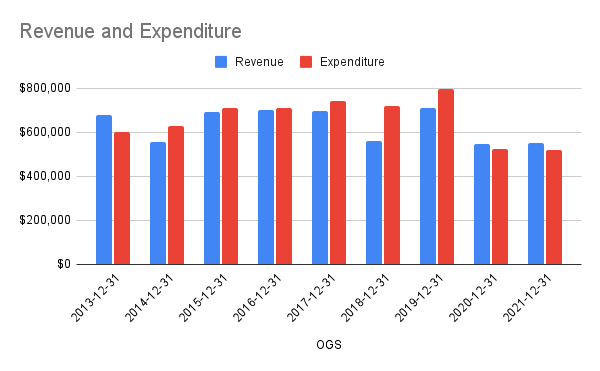 It’s the reduction in both revenues and expenditures in 2020 and 2021 that stand out for the Ontario G
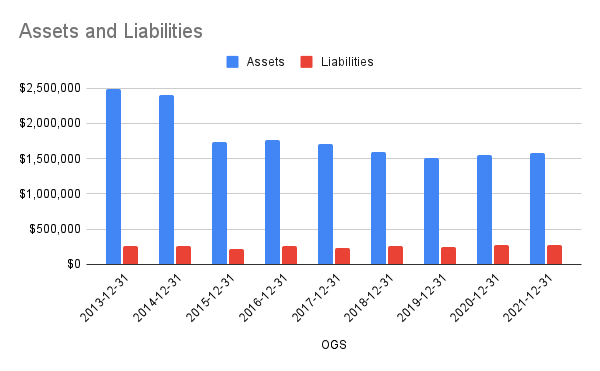 As a result the erosion of the asset base was halted. It had peaked in 2018 when assets decreased by nearly 12% owing to the operating deficit. As a rule of thumb societies like OGS should have a fairly liquid reserve fund of 25 to 30 percent of expenditures. OGS was well within that guideline, as long as it didn’t continue. It didn’t.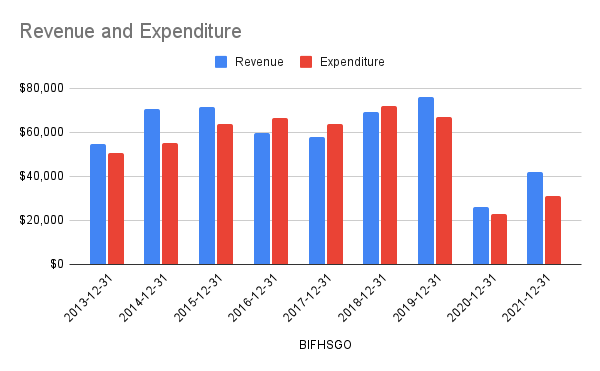





 The biggest Findmypast addition of the week is 7,795 burial records for the Kent communities of:
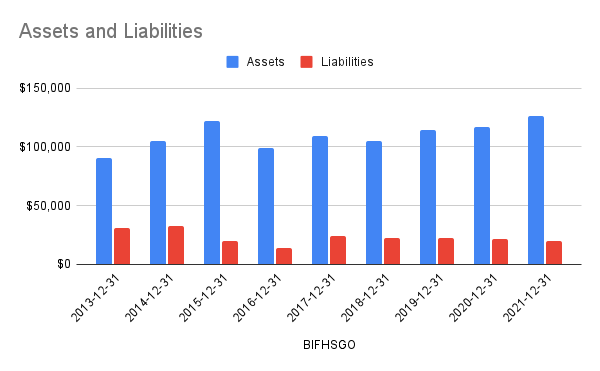
 BIFHSGO
 Like all
 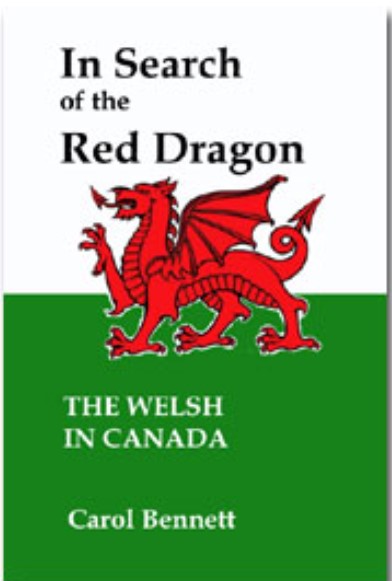 In Search of the Red Dragon – The Welsh in Canada, by Carol Bennett, describes Welsh immigration and settlements in Canada, discusses the survival of the Welsh language and cultural institutions in Canada, and tells the story of a number of notable Canadians of Welsh extraction.
 FamilySearch expanded its free online archives in November 2022 with over 46 million new, name-searchable genealogy records from 44 countries, including one expansive database from the world’s cemeteries in Find-A-Grave Index.