Exploring Family Tree Expert GPT

Family Tree Expert GPT “answers family tree/genealogy/
ancestry questions using your uploaded GEDCOM (.ged) file (which you can export from most family tree software). This GPT doesn’t connect to third-parties (e.g. APIs) so your data stays within ChatGPT. Conversation data from this GPT isn’t used to improve OpenAI models.”

It has 400+ conversations and a 3.0 rating.

Suggested conversation starters are:

Can you tell me who John’s parents are?
What is the birth date of Alice?
Find all individuals with the surname ‘Smith’.
Show me the marriage details of Robert and Emily.

I uploaded a 1,778 person gedcom from RootsMagic . Querying the database I determined:

1,224 people have no death information
1,642 people have no burial information
109 have both death and burial information
10 have lived in Australia
14 have lived in Canada (not including myself!)
7 were born in Wales and died in England
22 people had last name A******* (anonymized)
10 people had middle name A*******
14 duplicates were identified of which 9 had no known last name.
240 were identified who are or should be in the 1921 census and were age less than 100 years.

Overall, even though some of the stats could be found through RootsMagic, there were others I could not.

Interesting.


LAC Co-Lab Contributions: Recent Additions and Highlights

Every month, we report on the progress of Co-Lab Challenges. Recently, we’ve also been tracking the number of additional contributions made through Co-Lab. As of 21 May, 3,841 items in Collection Search were identified as Co-Lab-only contributions, an increase from 3,797 a month earlier.

LAC has provided a list of 62 new additions between 1 April and 24 May 2024,

  • 19 photographs
  • 19 art pieces
  • 3 documentary art items – maps and plans
  • 18 textual items – manuscripts
  • 3 other items

Co-Lab’s tasks include “transcribing, tagging, translating, and describing digitized records from our collection.” For the 41 image items (66%), this means tagging and describing.

For example, reference number 2919116, titled “Wellington Street near Bank Street, Ottawa,” likely has its contributed information within the Record Information – Details section.

Transcription, on the other hand, is more demanding. Item 5793108, “Letter to David T. Williamson from John and Annie Peters,” now includes a transcription of the handwritten letter on the final two pages.

In some additions, it isn’t clear what value has been added. However, aside from transcription, the tasks do not seem burdensome if you’ve found an item in your research that would benefit from enhanced tagging or description.

By contributing to Co-Lab, you can help enrich the records and make them more accessible for future researchers. Every little bit helps in preserving and enhancing our shared heritage.


Exploring Open GeneaGPT

Open GeneaGPT, by Steve Little, is a Genealogy GPT based on a collaborative source-available instruction set. An assistant for family history researchers, genealogists, and the generally curious. It has a rating of 4.7 and has been used in over 400 conversations.

Suggested conversation starters are:

How do I get started with genealogy?
What basic skills does a genealogist practice?
How do genealogists verify genealogical conclusions?

Why and how do genealogists write about their results?


To verify genealogical conclusions it preaches the genealogical proof standard.

In writing about results it mentions:
(1) Genealogical Reports: These detailed documents outline the research process, findings, and conclusions. …
(2) Narrative Family Histories: These are more story-like documents that weave together genealogical facts with historical context, personal anecdotes, and family lore. …r audience.
(3) Pedigree Charts and Family Trees: Visual representations of lineage that can accompany written reports. …
(4) Case Studies: These are in-depth explorations of a particular research problem or family line, demonstrating methodology, analysis, and resolution. …
(5) Articles and Blog Posts: Shorter pieces that can focus on specific discoveries, research tips, or historical context. …(6) Books: Comprehensive works that cover extensive research on a family or a particular topic within genealogy. …You are invited to explore further: “Would you like to delve (sic) into one of these writing methods in detail, explore examples of genealogical narratives, learn about specific tools and resources for writing, or discuss another topic?”

I asked for the outline for a Genealogical Report. It suggested:
Title
Table of Contents
Introduction
Research Objective
Summary of Findings
Research Methodology
Detailed Findings
Analysis and Discussion
Conclusion
Appendices
Bibliography

I asked for an example. The result seemed reasonable. To be sure it wasn’t hullicinating I fed it information for a situation I knew about . The result was impressive. While there were errors and omissions they would be easy to correct.

This Week’s Online Genealogy Events

Choose from selected free online events in the next five days. All times are ET except as noted. Assume registration in advance is required; check so you’re not disappointed. Find out about many more mainly US events at Conference Keeper at https://conferencekeeper.org

Tuesday, 28 May

2 pm: Ottawa Virtual Genealogy Drop-In. OGS Ottawa Branch
https://meet.google.com/nvz-kftj-dax

2:30 pm: How to do More Genealogy in Less Time with Goldie May, by Richard K. Miller for Allen County Public Library Genealogy Center.
https://acpl.libnet.info/event/10558471

7 pm: Murder, Bigamy and New Beginnings: The Infamous Edward Wicklow, by Elysia DeLaurentis for OGS Wellington Branch.
https://wellington.ogs.on.ca/events/wellington-branch-murder-bigamy-and-new-beginnings-the-infamous-edward-wicklow/

Wednesday, 29 May

2 pm:  Capturing Their Stories, Part II: Next Steps with Your Family History Interviews, by Colleen Robledo Greene for Legacy Family Tree Webinars.
https://familytreewebinars.com/webinar/capturing-their-stories-part-ii-next-steps-with-your-family-history-interviews/

Thursday, 30 May

8 am: Trouvez vos ancêtres à l’étranger sur MyHeritage, par Elisabeth Zetland pour MyHeritage et Legacy Family Tree Webinars.
https://familytreewebinars.com/webinar/webinaire-myheritage-en-francais-2/

6:30 pm:  A Guide to Custom Passenger Lists: 1820 – ca. 1891 (US), by Logan Knight for Allen County Public Library Genealogy Center.
https://acpl.libnet.info/event/10557868

Friday, 31 May

Saturday, 1 June

10 am: Irish Research in the Digital Age. by Nuala Farrell-Griffin for OGS London and Middlesex Branch.
https://londonmiddlesex.ogs.on.ca/events/london-and-middlesex-branch-irish-research-in-the-digital-age/

Exploring Custom AI Tools for Genealogy Research

Have you tried any of the specialized AI tools designed for genealogy and family history research? With the rise of advanced language models like ChatGPT, developers have created custom versions tailored for niche domains like genealogy. That’s not just human genealogy! By combining domain-specific instructions, curated knowledge bases, and fine-tuned skills, these AI assistants aim to provide enhanced capabilities for tasks such as record analysis, ancestry tracing, and family tree building.

Start by exploring the directory at https://chatgpt.com/gpts, which currently lists over 100 custom AI tools across various aspects of genealogy. Here are some of the top genealogy-focused offerings based on the number of conversations:

AI and Genealogy Research GPT: Explores how AI can assist in genealogical research, family tree analysis, and uncovering ancestry information. With 900+ conversations and a 3.9 rating, it’s one of the more popular options.

Open Genealogy GPT (Open GeneaGPT): A collaborative, source-available genealogy assistant for family history researchers and the curious. It has garnered 400+ conversations with a solid 4.7 rating.

Genealogy Eyes: This unique tool leverages computer vision to analyze images, photos, and documents through the lens of a family historian. Upload an image (e.g., a cemetery headstone or historical record) from your phone using the official ChatGPT app, provide context, and let the AI assist you. With 400+ conversations, it has a 3.7 rating.

While these tools offer intriguing possibilities, access is usually limited on the free tier. All these restricted access to paid subscription plans like ChatGPT Plus. As exploring and experimenting with the available capabilities can provide valuable insights into the potential of AI for genealogical research, at $20 US per month it’s something I can only recommend on a trial basis.

Have you had any experience with these or other custom AI tools for genealogy? Share your thoughts and findings in the comments!

Evidence Explained Discount

This is following up on mentioning the 4th edition of Evidence Explained in last week’s review of WDYTYA magazine’s June issue.
There’s a 15 percent discount at Genealogical.com until May 30th as part of a site-wide sale.
So that you know, the hard copy version is not available outside the US.

Military Monday

It’s War on the Streets of Paris is a post with a map on the Maps Mania blog,

Around 15% of Paris’ streets have names which are related to battles, soldiers and/or resistance fighters. Streets which are named for important battles are coloured green . Streets coloured blue are named after generals and other important military figures. Heroes of the French resistance are commemorated in the streets coloured red on the map.

The areas around the Arc de Triomphe and the Bastille-Arsenal both have a large concentration of streets bearing military related names.

It set me to thinking about streets in Ottawa commemorating the military. There’s Col By Drive, Wellington Street, Vimy Place (and Bridge), Juno Street, Pretoria Bridge, and Breadner Boulevard. How many am I missing?

OGS Toronto Branch Presentation: The Trial of William Brass

At 7:30 pm on Monday, Toronto Branch’s May presentation, The Trial of William Brass, is presented by Carol Ufford in person and online.

In 1837, Carol Ufford’s third great-uncle, William Brass, was charged with raping a young girl. His defense attorney was young John A. Macdonald. Using documents from the Haldimand collection, the Upper Canada Sundries, and contemporary newspapers, Carol will tell William’s story—his early life, what lead up to the trial, the trial, and the aftermath.

Find out more and register at https://torontofamilyhistory.org/


Sunday Sundries

Miscellaneous items I found of interest during the week.
The Nerd Urban Dictionary

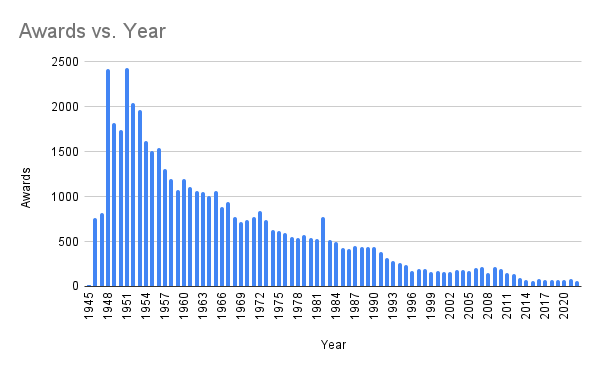
Male occupational structure of England and Wales 1381-2011
The shift from the primary (agriculture, forestry and fishing) to secondary (mining, manufacturing and construction) sectors happened earlier than previously thought.

When Online Content Disappears
38% of webpages are no longer accessible a decade later. What do you do to retain access to the information?

Find A Grave
Ancestry just updated the UK and Ireland version to over 20 million records,  the Canada version is over 10 million.

Whose communities? Provincial funding support for community museums in Ontario

Thanks to this week’s contributors: Allison, Anonymous, Teresa, Unknown.

TheGenealogist adds Army Lists

With its latest release of Army Lists from 1837 to 1959 there are 1.8 million new military records available to TheGenealogist subscribers.

The British Army Lists provide comprehensive details about officers and warrant officers, including their ranks, regiments, and service appointments. Find details of officers by regiment, rank and seniority, offering a detailed snapshot of the officer corps at any given time.

Findmypast Weekly Update

Here are this week’s additions which are for the county of Kent.

Baptisms are for the adjacent south of the Thames parishes of Greenwich, Charlton, and Woolwich and for Cliffe, Hadlow, and Ightham communities.

There are also additions for marriages in four unnamed parishes and burials in six, likely the same as for baptisms.

Identifying a Fallen Soldier of Vimy

The following is fiction.

For over a century, he had lain in the soil of the Vimy battlefield in France. One of the many with no known grave from the horrific Battle of Vimy Ridge during World War I. That’s until last year when advances in DNA technology finally allowed his identity to be revealed.

Private Graham Thomas was just 19 years old when he enlisted with the Canadian Expeditionary Force in 1916. From Cut Knife, Saskatchewan, he had rushed to join his older brother already fighting in Europe. Less than a year later, he found himself taking part in the battle to capture Vimy Ridge, a key strategic objective that saw over 10,000 Canadian casualties.

On April 9th, 1917, during the first waves of the assault, Thomas was struck and killed instantly. His mutilated body, rendered unidentifiable from the force of the blast, was  hastily buried by his comrades in a makeshift grave. Sadly, as the battle continued the grave was obliterated. His name found a place among the more than 10,000 on the Vimy Memorial.

In 2018 remains were discovered and retrieved.  Despite efforts by the Canadian authorities his identity could not be confirmed, including through comparisons of DNA samples to paternal Y-chromosome or maternal mitochondrial lineages. But last year, autosomal DNA analysis was attempted – examining the DNA across all of the chromosomes inherited from both parents. That’s the way so many cold cases are being solved today.

This turned up a match to DNA from Thomas’ great nephew who had taken a test on Ancestry out of casual interest in his ethnicity. After over a hundred years the genetic evidence conclusively identified the remains as those of Private Thomas.

In an emotional ceremony this past November, the soldier killed in the battle to take Vimy Ridge was finally laid to rest alongside his comrades with full military honours by members of the modern Canadian Armed Forces. 

While the years can never be returned to GrahamThomas, at last his sacrifice has been acknowledged, and he can take his rightful place of honour among the heroes of Vimy. Thanks to DNA technology, one family has brought their fallen soldier home.

What is not fictious is the Canadian authorities efforts to identify remains through Y-chromosome and mitochondrial DNA alongside physical evidence— too often insuffiicient. What is fiction is doing so through autosomal matching.